Dorset Heritage Museum
Short Stories

Dorset's First Motorized Vehicle
The International Harvesters truck was ordered from Toledo Ohio in 1913 by Hiram Barry. It was number 802 to have been built. It was shipped to Hamilton Ontario,and then sent on to Huntsville. It arrived in Huntsville in February 1913. It was such an occasion that the Huntsville Band was brought out to meet the new arrival.
The new motor wagon was driven over the ice of Fairy and Peninsula Lakes, across the height of land between North and South Portage, then across the ice of the Lake of Bays to Dorset.
The two men traveled with the International, one to teach Mr. Barry to drive it, the other gentleman was to teach him how to fix it! The payment these two gentlemen wanted was to be taken on a few fishing trips; for they had read how great our lakes and area were for fishing and hunting.
The main use for the International at that time was to cadge supplies into the Lumber Camps.
Hiram Barry owned and operated Dorset’s first garage and his family still do today!

Making Amends
In the late 1990s the Clayton Family received a letter addressed to the ‘Claytons of Dorset’. The letter was from an 80-year-old gentleman who was from New York State. This man had attended Camp Otter on nearby Otter Lake. In the 1930s. The letter stated that he had stolen some chocolate bars from Claytons General Store while his teenage friends had kept D.W. Clayton busy at the back of the store.
For 60 more years he had felt guilt and, thus he sent a letter of apology and a cheque for $20.00 to cover his theft. He wanted to finish his life with a clear conscience.
You can stop in to the Dorset Heritage Museum to visit our ‘GENERAL STORE’ exhibit. View photos and artifacts of Claytons General Store. The museum also has an exhibit featuring area camps, one of which is Camp Otter.

Wedding Month
June is traditionally known as wedding month, and we invite you to step into the past and explore Dorset's weddings. Our permanent exhibit presents over 65 years of Dorset couples tying the knot.
From the early 1900s to the 1960s, timeless wedding fashions, traditions, and memories are on display, including a beautifully preserved wedding gown worn by a local bride in June 1901. Captured in photographs, visitors get a glimpse into Dorset's families and their friends as they celebrated that special day, and love was in the air. We invite you to 'walk down the aisle' anytime at the Dorset Heritage
Museum.
Did you say, "I Do" in Dorset? We'd love to see your wedding photos, please email the museum with your stories and photos to dhm@muskoka.com ❤️

Chief John Bigwin
Long before the iconic Robinson's General Store and the Dorset Scenic Lookout Tower, the area where the village of Dorset is located on Lake of Bays was the summer campground for the families of Chief John Bigwin. His ancestors, the Anishinaabeg, were the original occupants of the area.
The area was a natural corridor for navigation and travel, serving Indigenous communities as a trading hub to exchange furs, goods, and resources. Seasonal crops like corn and potatoes were grown, and the
area was rich in wild game, fish, and birch bark for making canoes, and it had prime locations for drying and processing furs.
Every spring for decades, Chief Bigwin and his family made their way from Mnjikaning (Rama) by canoe north to Lake of Bays, where they had a settlement at Cedar Narrows, now known as Dorset. There they established hunting camps and settlements before returning to southern Ontario regions for the winter.
Visit us to see and learn more about the history of Dorset.

Did You That Dorset Hasn't Always Been Called Dorset
First settled in 1859 with its location along the channel of the cedar - lined narrows of Lake of Bays, Dorset was originally called Cedar Narrows. In later years, the settlement became known as Trading Bay after early settler Francis Harvey's pioneer trading post, which sprang up along the narrows.
Then for a brief time, it was renamed Colebridge after early pioneer and area surveyor Zachariah Cole. The villages main street straddled the boundary between the geographic townships of Sherborne and Ridout, both surveyed in the early 1860s.
It was then discovered that an existing town in Ontario was already registered as Colebridge, so the name would have to change if the residents wanted to have a post office.
At that time, a resident of the village had migrated from the market town of Sherborne in rural northwest County of Dorset, England. As the local village township was already named Sherborne, the name "Dorset"
was chosen to honour their home county of Dorset, England. Dorset's post office was opened on October 1, 1879.
Visit us to see and learn more about this story and the history of Dorset.

A Short Story from Charlie Burk
He remembered... In 1919 Dorset that his father sold many items in the General Store, groceries, drugs, and dry goods too varied to name them all. The flour and sugar came in 100-pound bags, candy, ice cream and beer. This beer was in quart-size bottles and came in wooden cases. The cases were used also to send the empties back to the wholesaler. Charlie remembers wheeling many of these cases up from the main dock after they had been unloaded from the boats and taking the empties back to the docks in the wheelbarrow, a necessary vehicle in those days.
Gasoline and kerosene came in steel barrels and were rolled by hand from the dock to the store where they were emptied into tanks. On one side of the store they had an ice cream parlour, a barber shop and a poolroom. The ice cream came on the boat too and was in ten-gallon cans set inside a wooden container large enough to pack a considerable amount of ice around to keep it frozen whileshipping from Toronto.
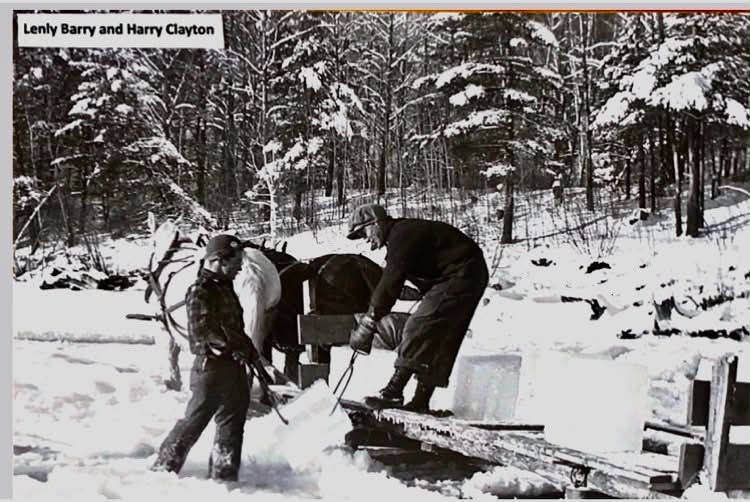
It was put into their outside containers and repacked with ice and rock salt as soon as it arrived. This required a large amount of ice to be cut in the winter and stored in their ice house.
Top left: Painting of the Burk family store beside the hotel.
Below: Lenly Barry and Harry Clayton cutting ice in the winter.
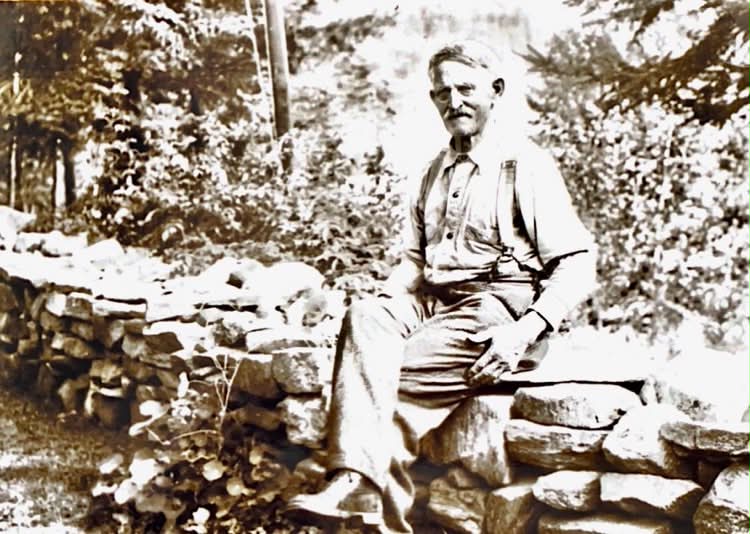
Bottom: A photo of Charlie Burk in his later years.